
How Frame's validators are being designed to keep the network fast and final, why every transaction is quantum-safe, how the bridge stays locked to consensus, and the deliberate, staged path to decentralization.
Frame now operates as part of a publicly traded company.
Rather than mark that with another milestone announcement, we wanted to start showing how Frame is actually being built. We are beginning with the part everything else rests on: the validators being designed to secure the network, and the deliberate, step by step path being taken to hand the network over to the community.
This is the first in a series that walks through how Frame works. We have kept it readable on purpose and held the deepest technical mechanics back, since there is far more underneath each of these ideas than we have put on the page. And if you would rather watch any of this than read it, the interactive Network Explorer is linked throughout, so you can open it alongside and follow along as you go.
What a validator normally does
On most blockchains, a validator is a computer with a straightforward job. When someone makes a transaction, it checks that the transaction is valid, agrees with the other validators on the correct order of events, and writes that agreement permanently into the chain, the shared record that no single company controls. Validators are the referees and the record keepers at once.
The limitation is in how most networks organize them. The validators usually share one global queue, a single line that every transaction has to wait in. They compete to order that line. Each transaction is broadcast into a public waiting room that anyone can see, and several confirmations later it settles, with some hope that the order has not been quietly reshuffled along the way. It works, but it comes at a cost. It caps how fast a network can go, it leaves transactions exposed on a public stage before they are final, and it asks people to treat "probably settled" as good enough. Frame is being designed from a different starting point.
How Frame is different
Frame is being designed without that single global queue - instead, the network is being built to be split up by region, divided across continents, with the work inside each region broken into parallel lanes. The difference is easiest to picture this way: rather than one line that everything in the world has to wait in, the design has many lines running at the same time, in different parts of the globe. The technical name for this is region partitioning, but the idea is simple, more lines mean more can happen at once.
Consensus, the process by which all the validators reach agreement, is meant to move through those layers in a steady rhythm. The lanes seal their own slice of transactions locally, the regions confirm what their lanes have produced, and the globe folds everything together into a single block, with the aim of one global block each second. The intent is a predictable heartbeat that holds whether the network is quiet or busy.
There is also no public waiting room in the design. A transaction would be sent straight to its lane automatically, sorted by a hash, a kind of digital fingerprint, with no shared holding area, what the industry calls a mempool, for anyone to watch, bid against, or reorder. We will name the pieces here, the dual-pulse consensus, the region-based committees, and the absence of a public mempool, and let the Explorer show you the shape of them rather than asking you to picture it. How each one works underneath is its own longer story.
What this design is built to do
The architecture is not different for its own sake. It is meant to change what using Frame feels like.
- When a transaction confirms, it is intended to be final at that point, meaning there is nothing to reorganize, roll back, or wait through before it feels safe. One confirmation is meant to be the end of it.
- With no public mempool, there is no stage where a transaction sits exposed before it settles, which is intended to remove front-running, where someone spots your pending transaction and jumps ahead of it for profit. A public waiting room invites exactly that, and the design has no such room.
- The network is being designed to get faster as it grows. Adding validators adds lanes, and more lanes raise throughput, the amount the network can handle, while the cost of running any single validator is meant to stay flat. The network scales up without the load on each operator scaling with it.
The last point is the one that matters most. Frame is being designed to launch lean and to grow from its starting set of validators, its genesis set, toward a global, many-continent network, with the design targeting over a million transactions per second, and without the people running it needing larger and larger machines. The full scaling story has some surprising numbers in it, which the Explorer lays out.
Quantum-safe signatures, without the slowdown
Frame is being built to be post-quantum from the ground up. A signature is the digital proof that a transaction really came from you, and the plan is for every transaction to carry a quantum-resistant one, with the traffic between validators encrypted using quantum-resistant cryptography too, as the default rather than an add-on. The concern this addresses is a real one: the cryptography protecting most of the industry today could one day be broken by quantum computers, powerful machines that do not yet exist but are coming. The aim is a network that stays secure even against them.
There is usually a cost to that. Post-quantum signatures are larger and heavier than the signatures most chains use today, and carrying them tends to slow a network down. Frame is being designed to avoid most of that cost, and the reason is the region-based structure. Because the full transaction data is meant to stay inside its home region while only small summaries travel across the world, the network can be designed to carry these larger, future-proof signatures without a network-wide slowdown. The specific algorithms have names, and the way they are threaded through the network is worth a closer look than one paragraph allows.
Following one transaction
The clearest way to understand the design is to follow a single transaction from start to finish, which is what the Explorer's Journey view shows.
- A user taps send. There is no gas auction, no bidding war over fees, and no queue to buy a way out of, so the journey starts at once.
- The transaction is signed, sealed with a post-quantum signature.
- It is routed to a lane by a hash, with no public mempool, so there is nothing to watch and nothing to front-run.
- The lane reaches agreement on its batch, while every other lane does the same in parallel.
- A random committee verifies it, with independent validators confirming each transaction is correct.
- Spot auditors, randomly chosen validators, check the work again against the record.
- It folds into the global block and is final.
Start to finish, the design targets roughly one and a third seconds, ending in a single, irreversible confirmation. The Explorer shows it in motion.
The bridge
Frame is being designed to connect to a range of other blockchains so assets can move in and out. That connection is called a bridge, and bridges have historically been the most dangerous part of any network, the corner that gets attacked again and again. So the design is built around a single rule: the bridge can never move faster than consensus. It cannot act until the validators have agreed.
Funds would only leave Frame after Frame's own validators have finalized the transaction and produced cryptographic proof that a supermajority of them agreed, in effect a sealed certificate showing that more than two-thirds of the network saw it, ordered it, and committed it. No single person or entity is meant to hold the bridge keys. Instead they would be generated and split into pieces across independent enclaves, sealed and tamper-resistant compartments, through a process called distributed key generation, so the wallet can only act when enough validators sign together. The signing logic itself is designed to live as fixed, unchangeable code inside those compartments. What the design aims for is simple: funds cannot move unless the validators have reached consensus and signed off.
The bridge is not meant to act on its own authority. It carries out what the validators have already approved, and nothing else. There is more to how those signing components stay independent than a few lines can hold.
How validators secure the network
Taken as a whole, the security model comes into focus. Frame is being designed to protect the network not with one gate but with layers of independent checks.
A random regional committee would verify each block. A random global committee would finalize it. Random spot auditors would then re-check the work against the real data. The part that makes it hard to cheat is the timing: validators commit to their part before they learn which role, if any, they have been given. You cannot position yourself for a job you do not know is coming, and the draws are designed so they cannot be predicted, bought, or gamed.
What this is built to produce is a network where a single honest auditor is enough to catch and prove fraud, and where dishonesty is penalized automatically. Everything above, the speed, the scaling, and the bridge, is meant to sit on top of this. Safety and network integrity come first.
The road to decentralization
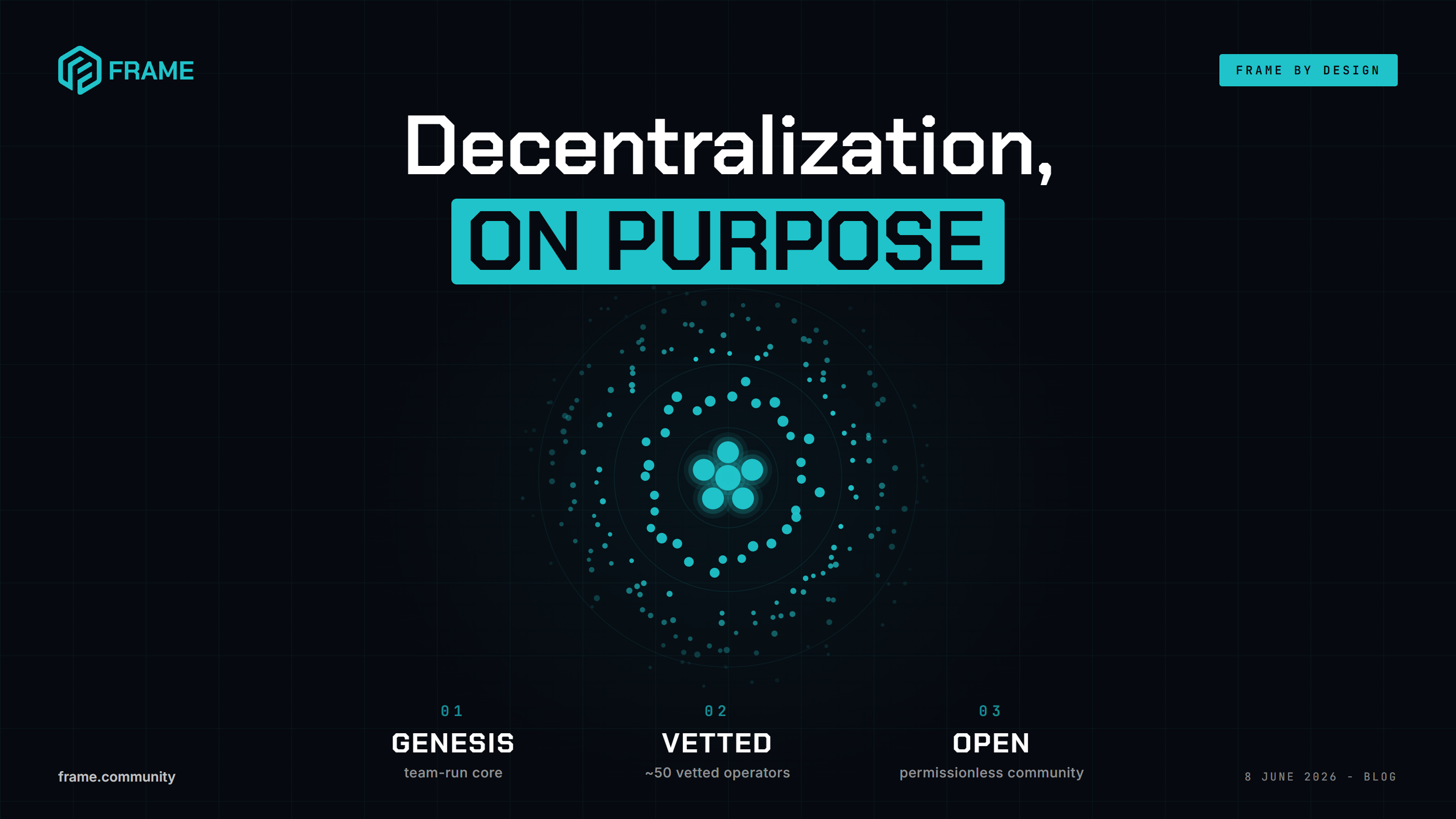
So where do the validators come from, and how does the network end up in the community's hands? This is the part we most want to be clear about, because it is a deliberate, staged plan rather than an accident or a limitation. It is being designed to open out in three layers.
The genesis layer is the backstop. At the core sit the genesis validators, team-run computers inside secure, hardware-protected enclaves, sealed compartments that resist tampering. They are meant to do two things. First, keep the network live, so block production does not halt, even at the start. Second, act as an integrity backstop while the validator set is still small, so that bad blocks, double-signing (a validator dishonestly approving two conflicting versions of events), or malicious behavior cannot slip through during a young network's most vulnerable phase.
The vetted layer is proven operators. Around that core, the plan is to bring on a set of roughly fifty vetted validators, individuals and institutions sourced from across the industry, each identity-checked and, for companies, business-verified (the industry terms are KYC and KYB) and reviewed before being trusted to help secure the network. These would be real, independent operators, the first widening of the circle beyond the team.
The open layer is the community. A permissionless queue, an open line anyone can join without needing permission, is being designed to let anyone line up to run a validator, with new community validators activated at random from that queue about once a month, after the four legacy community validators that have run this kind of infrastructure before. It is meant to be an open, ongoing on-ramp, decentralization that keeps widening on a schedule rather than all at once. Every operator who joins adds lanes and reach, raises throughput, and shrinks the team's role by design.
Why this order matters: a network has to prove it is safe before control is handed out to thousands of independent operators. Starting with a trusted core, widening to vetted operators, then opening to everyone is how the whole network can be protected during its most fragile window, and every step of that handover is meant to be visible. The whole point of the sequence is integrity, and protecting the network through the phase where it is most at risk.
This is just the start
This is the beginning, and there is more to come. For now, you can see it all in motion in the interactive Network Explorer: trace a transaction, grow the network from its genesis set toward fifty thousand validators, and see how the bridge handles a transfer.
Explore the Frame Network → frame.community/transaction-finality
We will be hosting an AMA on Thursday 18th June, 7pm UTC. People should bring their questions on this topic.
Discord AMA · Set reminderThursday 18 June · 7pm UTCIf you want to keep up with the validator program as it develops, and hear from us as the network grows, you can add your name below.
As always, our Discord and Telegram are the most active spaces. The team is present there, updates land there first, and it is where we would love to see the community grow.
Forward-looking statements: This post describes the intended design, planned features, and development of Frame Network, including performance targets and architecture still being built. The figures and targets here, including those shown in the Network Explorer, are projections rather than guarantees, and the features described are not currently available and may change or may not be released. These statements reflect current expectations and are subject to risks and uncertainties that could cause actual outcomes to differ materially. Nothing here is an offer to sell or a solicitation to buy any security or token, or a commitment as to timing, returns, or specific outcomes. Frame Network operates as part of The Crypto Company (OTC: CRCW), a publicly traded company. Readers should not place undue reliance on forward-looking statements, which speak only as of the date published.